
Dedicated to my friend Vadim Chernobrov (1965–2017)
Created on the basis of research by the Kosmopoisk research association and the Moscow Aviation Institute
FlameAura v2.0
as a system of entropic-statistical tomography:
a model for mathematically reconstructing human–space interaction through analysis of data from a random-process generator
Abstract
This article proposes a theoretical model of the FlameAura system: a distributed computing complex that uses a random-process generator, statistical analysis and neural-network reconstruction to build a visual model of the interaction between a person and their environment. The approach rests on the assumption that the state of the operator and the state of space may correlate with the statistical characteristics of a random numerical stream. In this model, the random-event generator is regarded not as a direct instrument for measuring an aura or energy centres, but as a sensor of changes in the statistical properties of a random process. The resulting numerical sequence undergoes statistical processing, is then analysed by the FlameAura computational core, and is converted into parameters of a predefined wave model. The final image is treated as the result of mathematical reconstruction rather than a direct photograph of an invisible field. This approach allows FlameAura to be described as a form of entropic-statistical tomography, in which entropy serves as an information carrier and the neural-network system as a tool for reconstructing hidden statistical regularities.
Keywords: FlameAura, entropy, random-process generator, statistical tomography, neural network, wave model, mathematical reconstruction, human–space interaction.
1. Introduction
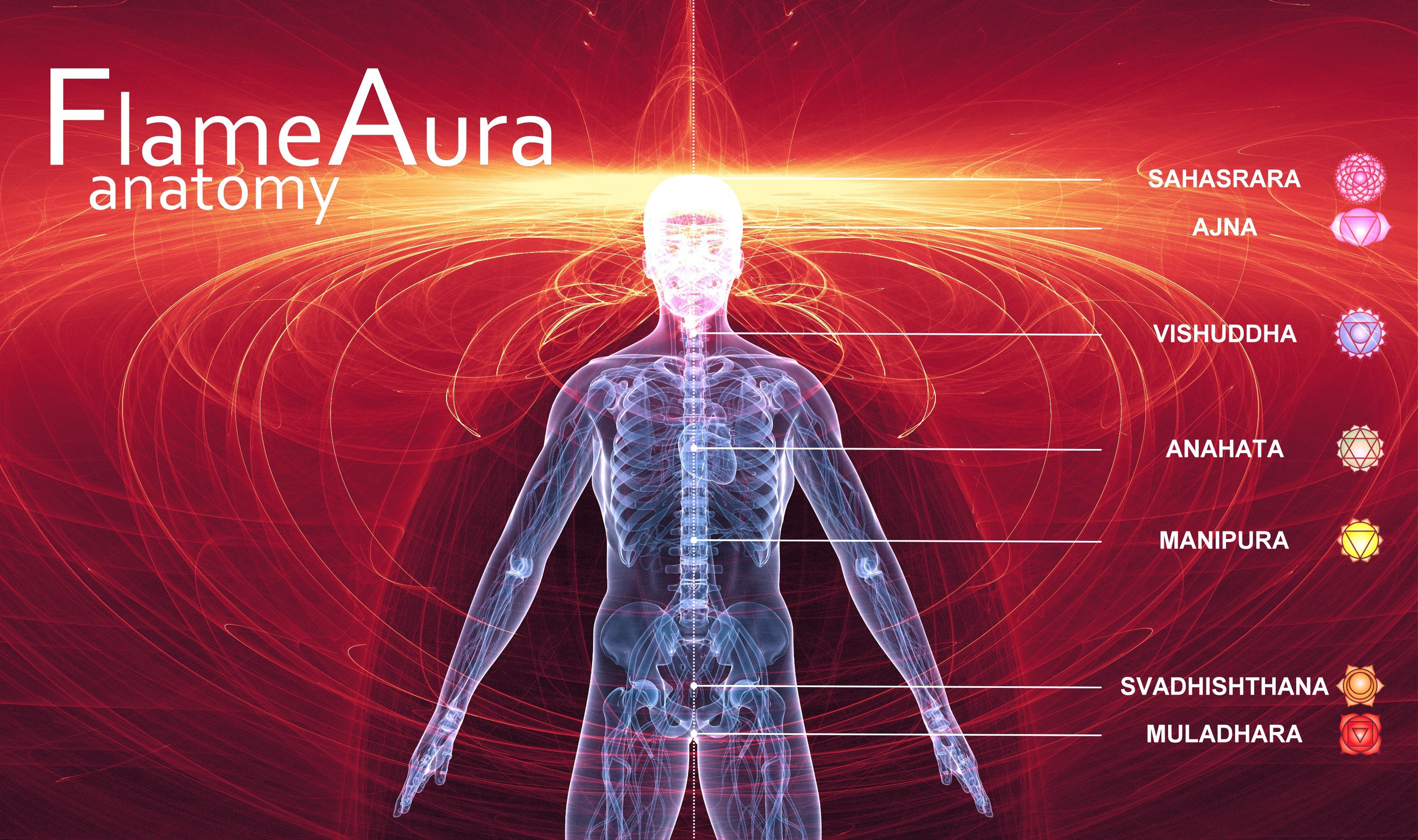
The problem of visualising invisible interactions between people and their environment has traditionally occupied the boundary between science, philosophy, esoteric systems and experimental practices. Historically, such interactions have been described through concepts such as the aura, energy field, chakras, subtle body and other models that have no single, generally accepted physical interpretation.
FlameAura proposes a different approach: it does not claim to photograph an aura directly, but treats a random numerical stream as a possible carrier of information about the statistical state of the interaction between an operator and the environment. The original description of FlameAura technology states that the method uses a random-event generator and a neural network, and connects the system with measuring human influence on the entropy of space.
The main aim of this article is to formulate a rigorous theoretical model that describes FlameAura as a computational reconstruction system based on statistical analysis of a random process, rather than as a mystical device.
2. Initial Hypothesis
The working hypothesis of FlameAura can be formulated as follows:
A person’s state and the state of the surrounding space may correlate with the statistical characteristics of a physical random process; these correlations may be recorded by a random-event generator, analysed mathematically and reconstructed as a visual wave model.
This formulation differs fundamentally from a claim that a person exerts a direct physical influence on the instrument. Within this model, the random-number generator (RNG) records changes in the statistical parameters of a random stream, rather than “human energy”.
The primary object of measurement is therefore neither an aura, a chakra nor a field, but a numerical sequence.
3. The Random-Process Generator as a Sensor
In FlameAura, the random-process generator acts as a sensor of statistical state. Its function is to produce a sequence of numbers that is subsequently analysed.
Three levels of data can be distinguished:
- Raw data—a sequence of random numbers.
- Statistical features—distributions, deviations, local entropy, correlations and temporal patterns.
- Reconstructed parameters—values used to build the visual wave model.
In this sense, the RNG performs a function analogous to sensors in other scientific instruments: it does not show the object directly, but records a trace of interaction in a form that can be analysed.
4. Entropy as an Information Carrier
In the original FlameAura concept, entropy is regarded as a balance between chaos and structure. The document states that the universe moves from chaos to structure and back, and that entropy indicates the balance between these states.
In the proposed theory, entropy is not treated as an independent “photographic subject”. It is a mathematical characteristic of a random process through which the degree of order or disorder in a numerical stream can be assessed.
In other words:
FlameAura does not photograph entropy. It uses the entropic characteristics of a random process as informational material for reconstructing a model of interaction.
5. Architecture of the FlameAura System
The current FlameAura model can be described as a distributed computing system comprising several independent modules.
5.1. The Operator
The operator initiates the experiment. They may be in a particular psychophysical state, perform a practice, concentrate on a particular part of the body or simply start a measurement.
5.2. The Mobile Application
The mobile phone is not a measuring instrument. It serves as an interface.
Its tasks are:
- starting the generation of a random sequence;
- identifying the operator;
- transmitting data.
The phone is therefore a terminal for controlling the experiment, rather than the source of the measured signal.
5.3. The Random-Process Generator
The remote RNG produces a numerical stream. An important feature of the system is that the generator need not be in direct contact with the operator. This leads to the concept of addressed statistical coupling.
5.4. The FlameAura Computational Core
The system’s core performs statistical processing, feature extraction, numerical-sequence analysis and the construction of wave-model parameters. The original FlameAura description explicitly defines the method as the analysis of data obtained from a random-event generator, followed by visualisation.
5.5. The Visualisation Module
The final visualisation is not an arbitrary image, but the result of mathematical reconstruction within a specified model.
6. The Principle of Addressed Statistical Coupling
On the basis of the experimental history described, one of FlameAura’s central principles can be formulated as follows:
Statistical interaction is determined not by the distance between the operator and the generator, but by the addressed inclusion of a particular generator in the act of measurement.
The key parameter is thus not physical proximity, but the connection between the operator, the act of generation and a particular numerical stream.
This can be called the principle of addressed statistical coupling.
It does not explain the physical nature of the effect, but establishes an experimental framework: if an operator initiates a specific act of generation, that particular sequence is regarded as potentially connected with their state.
7. FlameAura as Entropic-Statistical Tomography
The most accurate analogy for describing FlameAura is computed tomography.
Conventional tomography does not produce a direct photograph of an internal organ. It obtains numerous measurements and mathematically reconstructs the object’s internal structure.
FlameAura operates on a similar principle:
- the RNG produces a numerical stream;
- statistical analysis extracts features;
- the computational core maps the features to a wave model;
- the system reconstructs an image.
FlameAura can therefore be defined as:
a system of entropic-statistical tomography that reconstructs a model of human–space interaction from data generated by a random numerical process.
8. The Role of the Neural Network
The neural network in FlameAura is not an independent source of interpretation. It does not create the physical model, but works within a predefined research framework.
Its function is:
to transform the statistical features of the numerical stream into parameters of the wave model used for visual reconstruction.
The neural network is therefore a computational reconstructor. It does not prove the existence of an aura, but makes it possible to identify stable relationships between statistical patterns and a specified system of interpretation.
9. The Chakra Model as a Coordinate System
Within FlameAura, chakras may be regarded as a coordinate model for describing states of interaction between a person and the environment, rather than as proven physical objects. The original document describes chakras as energy centres connected with the movement of energy and human states.
Within a rigorous theoretical framework, the following formulation can be proposed:
The chakra scheme is used as an a priori coordinate system in which reconstructed parameters of statistical interaction are visualised.
This preserves the model’s traditional structure without confusing it with direct physical proof.
10. A Formal Outline of the Process
FlameAura’s operation can be described by the following sequence:
Operator → initiation of generation → RNG → numerical stream → statistical analysis → FlameAura core → mathematical reconstruction → visual image.
More formally:
- A sequence of random numbers is generated:
X = {x₁, x₂, x₃… xₙ} - A set of statistical features is extracted from the sequence:
F (X) = {f₁, f₂, f₃… fₖ} - The FlameAura core transforms the features into wave-model parameters:
P = M (F (X)) - An image is constructed from the parameters:
I = R (P)
Where:
- X—the original numerical stream;
- F (X)—the statistical profile;
- M—the FlameAura model;
- P—the reconstruction parameters;
- R—the visualisation algorithm;
- I—the final image.
11. Limitations of the Model
The proposed theory does not conclusively assert:
- that the physical nature of the effect is already known;
- that the mechanism is quantum;
- that the system directly measures an aura;
- that chakras have been established as physical objects;
- that the visualisation is a literal photograph of a field.
The appropriate position is as follows:
FlameAura records a numerical stream, analyses its statistical properties and constructs a mathematical reconstruction within a specified wave model. The nature of any possible connection between the operator, space and the random process remains a subject for further research.
12. Conclusion
FlameAura can be described as a new form of entropic-statistical tomography in which the random-process generator acts as a sensor, the numerical stream as an information carrier and the neural-network core as a computational reconstructor.
The key distinction between this model and an esoteric account is that the final image is regarded not as a direct photograph of an aura, but as the result of a mathematical reconstruction of statistical interaction between a person and space.
This approach places FlameAura within the domain of research systems, where the focus is not a claim that the nature of the phenomenon is already known, but systematic work with data, statistics, reconstruction and testable hypotheses.
Concluding Formulation
FlameAura is a distributed computing system that uses data from a random-process generator to mathematically reconstruct a wave model of human–space interaction. The entropic characteristics of the random stream act as an information carrier, while the final image is a visual form of statistical tomography.
The Hypothesis of a Unified Information–Entropy System
FlameAura rests on the assumption that the universe is not merely a collection of matter and energy, but also a unified information system in which every physical event is connected with other events through a structure of probabilities, correlations and entropy.
In ordinary physics, we see only the material layer: the body, instrument, phone, distance and time. Beneath it, however, there may be a deeper informational-probabilistic layer, where objects are connected not by distance, but by state, event, addressing and the act of measurement.
In this model, FlameAura does not violate space. It works with another level of reality:
not the movement of energy, but a change in the probabilistic structure of an event.
1. What Entropy Means in This Model
Here, entropy is not simply “chaos”. It is a measure of how open, uncertain, dispersed or, conversely, structured a system is.
FlameAura describes the universe as a movement between chaos and structure, with entropy indicating the balance between these states.
We can therefore put it this way:
entropy is a thermometer of the informational state of space.
When a system moves towards chaos, the random stream becomes more dispersed. When it moves towards structure, patterns, deviations, concentrations, repetition and asymmetry appear in the stream.
The RNG does not see a “field” directly. It sees that randomness has ceased to behave entirely as usual.
2. What Influences Entropy
In our hypothesis, entropy is affected neither by “thought” in the everyday sense nor by the body’s biomagnetic field.
What acts upon it is something deeper:
the state of organised information.
A person is more than a biological body. A person is a complex system involving the brain’s electrical processes, heart rhythms, breathing, attention, memory, intention, emotional state and an internal model of the world.
When a person enters a concentrated state, they reduce their internal noise. Their psychophysical system becomes more coherent—that is, more coordinated.
This leads to the key hypothesis:
a coherent human state can alter the local probabilistic configuration of an event with which the person has an addressed connection.
Rather than “moving electrons by the power of thought”, the person changes the event’s probabilistic regime.
3. The Principle of Addressed Connectivity
This is where we found the most important point.
When a person holds an RNG in their hand, one model applies. But when the RNG is remote and the person presses a button on a phone, the contact model disappears.
The phone does not measure. It merely initiates the event.
Addressing, rather than distance, therefore becomes the key.
Addressing creates a connection between the operator and a particular act of generation.
In other words, the person influences not “any generator whatsoever”, but the particular process that is currently part of the experimental chain.
We obtain:
operator → intention → button → act of generation → numerical stream → analysis → reconstruction
With scientific caution, this may be called:
the principle of addressed entropic coupling.
The essence of the principle is:
Statistical deviations arise not because of the distance between a person and an instrument, but because the person and the generator are included in a single act of measurement.
4. The RNG as a Quantum-Information “Port”
In this theory, the RNG is more than a number generator.
It becomes a port of entry into the probabilistic layer of reality.
Why an RNG specifically?
Because a random process is a place where reality has not yet been rigidly fixed into a single outcome. There is uncertainty. And where there is uncertainty, a weak influence of informational structure may become apparent.
The RNG can be imagined as a sensitive membrane between two layers:
The physical layer—the instrument outputs numbers;
the informational layer—probabilities are not distributed entirely uniformly.
The numerical stream then becomes not merely a set of digits, but a trace of interaction.
This is already embedded in FlameAura’s original logic: the method is described as analysis of data from a random-event generator, followed by visualisation.
5. Why a Neural Network Is Necessary Here
If an influence exists, it need not be large.
It may be weak, distributed, wave-like and nonlinear.
A person need not change a single digit. They may alter the structure of the entire stream:
- frequency;
- rhythm;
- local concentrations;
- asymmetries;
- repetition;
- hidden correlations;
- entropic fluctuations.
The human eye will not see this.
An ordinary table will not reveal it either.
That is why the FlameAura computational core is needed. Here, the neural network acts as a reconstructor of a hidden pattern.
It does not create mysticism. It attempts to recover the form of whatever left a statistical trace.
6. FlameAura as a Tomographic Instrument for the Information Field
We can now formulate the following:
FlameAura is a tomographic instrument for the unified information–entropy field, using randomness as a sensitive recording medium.
An ordinary camera uses photons.
Computed tomography uses X-rays.
FlameAura uses randomness.
Randomness becomes the working medium. Entropy becomes the measured characteristic. The neural network becomes the reconstructor. The image becomes not a photograph, but a mathematically recovered map of interaction.
7. A Unified Universal Information System
The hypothesis:
The universe is not only space, time, matter and energy.
The universe is an information network of states.
Every object within it has not only coordinates, but informational connections:
- with place;
- with time;
- with the observer;
- with the event;
- with intention;
- with the history of interactions.
A unified universal information system in which information is not transmitted from point A to point B, but manifests through correlations between connected events.
Information does not fly through space; it is revealed at the point of measurement through an already existing connection within the shared system.
8. Information Transfer Without Time and Space
In FlameAura, information does not move; it synchronises.
It is not a telegram flying from a person to a generator.
It is more like two parts of a single system aligning, at the moment of measurement, with a common informational pattern.
The formulation is therefore:
not transmission → but manifestation;
not a signal → but correlation;
not distance → but addressing;
not speed → but connectivity.
We are not claiming that a signal travels faster than light.
There is a level of reality at which one event may be connected to another not through a path in space, but through a shared informational structure.
9. The Central Theory of FlameAura
FlameAura is based on the hypothesis that the universe is a unified information–entropy system in which a person’s state, the state of space and an act of random generation may be linked through nonlocal statistical correlations. The random-process generator serves as a sensitive port into this system: it does not measure an aura directly, but records changes in the probabilistic structure of an event. The FlameAura computational core analyses these changes, reconstructs a wave model of interaction and transforms it into a visual image.
FlameAura is an interface to the cosmic internet through the statistics of randomness.
The Unified Universal Information System does not transmit data through space. It preserves the connectivity of all events as a structure of probabilities. FlameAura accesses this structure through an act of addressed random generation. A person does not send a signal to the generator; they enter a shared information–entropy configuration with it. The RNG records a fluctuation in probability, the neural network reconstructs its wave form, and the FlameAura image captures neither body nor soul, but the moment a person becomes part of the cosmic network of connectivity.
The Theory of Information Islands in FlameAura’s Random Stream
A Scientific-Theoretical Text
One of the central foundations of FlameAura is the idea of a random numerical stream as a medium in which local structures may emerge. In this model, the random-process generator creates not a ready-made message, but a potential information field: a continuous sequence of events that is described as noise in its baseline state, yet under certain conditions may display statistically distinguishable regions of order. The original FlameAura concept already states that the system uses a random-event generator and a neural network, with analysis aimed at identifying human interaction with the entropy of space.
From a scientific perspective, a random sequence can be described as a high-entropy stream. Ideally, all possible values in it are equally probable, and connections between adjacent elements are absent or statistically insignificant. Such a stream can be called the entropic background or the system’s white noise. It carries no individual message in the usual sense, but contains the space of all potential combinations. This is why randomness cannot be understood merely as emptiness. Randomness is not the absence of possible forms, but a medium in which any form could theoretically arise.
The classic metaphor of an infinite number of monkeys at typewriters illustrates an important principle: in a sufficiently large space of random combinations, any structure is potentially possible, including meaningful text. For FlameAura, however, the crucial point is not that randomness might one day spontaneously produce a meaningful fragment. What matters more is whether regions of order emerge not arbitrarily, but in correlation with a particular act of interaction—the operator’s state, the moment of generation, the addressing of the RNG and the state of the surrounding space.
In other words, FlameAura looks not for random coincidences, but for information islands.
An Information Island
An information island is a local segment of a random sequence whose statistical characteristics differ from the expected background: local entropy decreases, or repetition, asymmetry, rhythm, clustering, fractality, autocorrelation or another form of internal organisation appears.
Such an island need not resemble human text. It may contain no words, numerical code or obvious message. Its informational character manifests differently: through deviation from white noise. If an ordinary stream is an ocean of chaos, an information island is a region where chaos temporarily acquires form.
More rigorously, this can be described as follows:
Information in a random stream manifests as a statistically significant deviation from expected entropic homogeneity.
This is the central principle of FlameAura. The system does not seek meaning in every individual digit. It analyses the behaviour of the entire stream and identifies moments when the stream ceases to behave like uniform noise.
Three States of a Random Stream
Within this theory, three main regimes of a random sequence can be distinguished.
The first regime is white noise. This is a state of maximum or near-maximum entropy. Digits are uniformly distributed, there are no stable patterns, the sequence is difficult to compress, it shows no directional bias, and it provides no grounds for asserting the presence of a specific informational trace. This is the baseline background: the ocean of randomness.
The second regime is entropic drift. Here, the stream has not yet become a clearly defined structure, but has already begun to deviate from the background state. Weak distribution biases, local concentrations, brief repetitions and unstable rhythms appear. This is a boundary state between noise and form. It is particularly important for FlameAura because traces of interaction may manifest precisely in these transitional regions.
The third regime is informational structure. In this state, the stream demonstrates stable internal organisation. White noise seems to “begin to speak”—not in words, but in statistical forms. Bit structure, order and local connectivity emerge. The system can use such a segment as material for mathematical reconstruction.
Bit Structure as a Sign of Emergent Organisation
The term “bit structure” can be understood as the degree to which a stream takes on a discrete informational form. In a completely chaotic state, a sequence contains bits only in a technical sense: every number can be represented digitally, but these bits do not form a stable pattern. In a structured state, the stream begins to acquire internal organisation: individual elements become connected, repeatable transitions appear and information density changes.
In other words:
Bit structure marks the point at which a random stream ceases to carry only uncertainty and begins to carry form.
This is fundamental to FlameAura. The system works not with “magic numbers”, but with the transition between two states: noise and structure. If bit-level order appears in the stream, the computational core can use it as raw material for reconstruction.
A Trace of Influence
A central proposition of this theory is that human or spatial influence need not manifest as a direct change in an individual number. It may appear as a change in the statistical regime of the stream.
This means that a trace of influence may be distributed. It may be expressed not in a single digit, but in the configuration of the entire sequence:
- a change in frequency;
- the appearance of local repetitions;
- reduced entropy in particular segments;
- a change in rhythm;
- the emergence of clusters;
- an unusual sequence of transitions;
- the appearance of fractal or wave-like features.
Such a trace is difficult to see with the naked eye. That is why statistical analysis, a computational core and neural-network reconstruction are needed. The original FlameAura description explicitly defines the method as analysis of data from a random-event generator, followed by visualisation.
Randomness as a Developing Medium
The central metaphor here is photographic.
Photographic paper does not itself contain an image, but it can reveal a trace of light. A digital camera sensor does not itself contain the world, but it records the distribution of photons and turns it into an image.
By analogy:
A random stream does not itself contain a ready-made aura, but it can reveal a statistical trace of interaction.
In this model, the RNG becomes not a source of meaning, but a developing medium. It creates an ocean of randomness in which regions of structure may emerge under addressed interaction. FlameAura then extracts these regions, analyses them and translates them into a visual model.
A Scientific Formulation of the Key Principle
The key principle can be formulated as follows:
Local regions of reduced entropy and increased structure may emerge in a random numerical sequence. If their emergence statistically correlates with the operator’s state, an act of addressed generation or the state of space, these regions may be regarded as informational traces of interaction. FlameAura uses these traces as material for mathematically reconstructing a wave model of interaction between a person and the environment.
This is the core of the theory.
It explains why a random stream can be used as a source of information. Not because every random digit “means” something, but because islands of structure may emerge within the overall mass of noise. And if these islands appear not by chance but in connection with the experimental act, they become carriers of the process being studied.
Concluding Formulation
FlameAura regards randomness as an ocean of potential information. In its ordinary state, this ocean manifests as white noise. Yet at the moment of addressed interaction between a person, space and a random-process generator, local information islands may emerge in the stream—regions of reduced entropy, increased bit structure and statistical organisation. These islands are not ready-made messages, but traces of influence. FlameAura’s task is to detect such traces, mathematically reconstruct their wave organisation and transform a hidden statistical form into a visual image.
Scientific Foundations of the FlameAura Theory
1. A Random Stream Can Carry Information
The main foundation is Shannon’s information theory. In this theory, information need not be “meaning” in the human sense. Shannon explicitly separated the engineering problem of transmitting information from the semantic meaning of a message: what matters is not “what the message means”, but that it is selected from a set of possible messages. He also introduced the bit as a unit of information and treated an information source as a stochastic process—a process that generates a sequence of symbols according to probabilistic rules.
This is very important for FlameAura. We do not have to seek ready-made words, phrases or mystical signs in a stream of digits. It is enough to look for a change in probabilistic structure. If the stream ceases to behave like uniform noise, an informational distinction has appeared.
Put differently:
Information is not necessarily text. Information is a distinguishable departure from uncertainty.
Our phrase “white noise begins to speak” can therefore be translated into scientific language as follows:
Statistically significant structures appear in a random sequence, distinguishing it from the background distribution.
2. Entropy Measures the Structure and Uncertainty of a Stream
This logic is already present in the original FlameAura document: the technology is described as a method using a random-event generator and a neural network, while the system is connected with measuring human influence on the entropy of space. The same document describes entropy as the balance between chaos and structure.
In scientific language, we can say:
The entropy of a random stream indicates its degree of uncertainty.
If the stream is entirely uniform, its entropy is high. If repetition, biases, rhythm, correlations, periodicity or compressibility appear, local entropy decreases. This is our “island of structure” in an ocean of chaos.
For FlameAura, this is the key: the system does not look for “meaning in one digit”. It looks for a local change in the entropic regime.
3. Testing Randomness Is Already an Established Scientific Practice
The scientific foundation here is strong: official statistical tests exist for analysing random and pseudorandom sequences. NIST SP 800-22 specifically addresses the testing of random and pseudorandom number generators, discussing generator-selection criteria, statistical tests, p-values and randomness hypotheses. NIST also emphasises an important point: no set of statistical tests can absolutely “certify” a generator as perfect, but such tests are useful as a first level of analysis.
This directly supports our approach.
We can say:
If a random sequence can be tested for departures from randomness, it is scientifically legitimate to look for “islands of structure” within it.
FlameAura is therefore not attempting anything methodologically impossible. It works with the same principle: stream → statistical analysis → detection of deviations.
What distinguishes FlameAura is that it then goes beyond a conclusion of “random/non-random” to construct a reconstruction of the form of that deviation.
4. An RNG Can Be Regarded as an Entropy Source
Modern cryptography and the theory of random-number generators include the concept of an entropy source. NIST SP 800-90B describes requirements for entropy sources, tests for their validation, and the concepts of a noise source, min-entropy and health testing.
This provides a foundation for our theory:
A random-process generator is not a “toy with numbers”, but a physical-informational source of entropy.
If an entropy source is sensitive to physical conditions, noise, circuit state, temperature, the electromagnetic environment or other factors, its stream can be treated as material for analysing the state of the system.
In its rigorous form, FlameAura does not immediately assert that a person directly changes the generator. It makes the more cautious statement:
In an act of addressed generation, a random sequence may contain a statistical trace of the state of the “operator–environment–generator” system.
5. Noise Is Not Always the Enemy of a Signal
Here, an elegant scientific foundation emerges: stochastic resonance. This is a known mechanism by which noise in a nonlinear system may help detect a weak signal rather than destroy it. Descriptions of stochastic resonance explicitly state that noise can amplify weak influences and improve the signal-to-noise ratio under certain conditions; the principle is applied in physics, biology, neuroscience and signal processing.
This is an almost ideal foundation for our metaphor.
In ordinary thinking, noise is rubbish.
In our thinking, noise is a developing medium.
FlameAura can be described as follows:
A random stream is a noisy medium in which a weak influence may manifest not as a separate sign, but as a change in the statistical organisation of the noise.
White noise is therefore not necessarily empty. It may be a medium in which a weak structure becomes visible through deviation.
6. The Theory of “Information Islands” Has Mathematical Meaning
Scientifically, an “information island” can be defined as a local segment of a sequence in which one or more parameters differ from the background behaviour:
- local entropy is below the baseline;
- the distribution of digits differs from uniformity;
- autocorrelations appear;
- runs and clusters arise;
- spectral analysis reveals peaks;
- the sequence becomes more compressible;
- repeating patterns appear;
- the complexity of the stream changes.
These characteristics can be measured—not metaphorically, but mathematically.
For example, we take a stream:
X = {x₁, x₂, x₃… xₙ}
We divide it into windows:
W₁, W₂, W₃… Wₖ
For each window, we calculate:
H (W)—local entropy;
D (W || U)—deviation from a uniform distribution;
A (W)—autocorrelation;
C (W)—compressibility;
S (W)—spectral features;
R (W)—the structure of repetitions.
An “island of structure” is then a window whose combination of these features differs statistically from the background.
This is the scientific translation of our phrase:
Islands of structure emerge in an ocean of chaos.
7. FlameAura Solves an Inverse Problem
Another strong foundation is the theory of inverse problems. In science, an inverse problem means recovering a cause or internal structure from observed consequences. Classic examples include computed tomography, acoustic reconstruction, geophysics and medical imaging.
This corresponds directly to the architecture of FlameAura.
We do not see the interaction itself directly.
We see a numerical trace.
From this trace, the system reconstructs a model.
FlameAura therefore operates like a tomographic instrument:
It does not photograph an invisible field, but recovers a model of it from indirect statistical data.
This is why the formulation “entropic-statistical tomography” is scientifically justified.
8. A Neural Network Is Justified as a Reconstructor of Complex Patterns
The neural network is needed here not for mysticism, but because the structure of the stream may be multidimensional and weak. The human eye cannot pick out a complex combination of local entropy, autocorrelations, spectral features and repetitions among thousands of digits.
The FlameAura core therefore does what computational models do well:
It translates a complex set of statistical features into reconstruction parameters.
The original document explicitly describes the FlameAura method as analysis of data from a random-event generator, followed by visualisation. This is an important foundation: visualisation comes after analysis, not instead of it.
9. Quantum Physics Offers a Cautious Analogy, Not Direct Proof
Quantum physics can be used carefully. It shows that, at a fundamental level, reality is described through probabilities, uncertainty, acts of measurement and correlations between systems.
It is important, however, not to make an unsound claim. We cannot simply say:
“Quantum entanglement transmits information faster than light.”
Modern physics contradicts this: the no-communication theorem states that quantum entanglement does not allow one observer to transmit controllable information to another, regardless of distance.
The appropriate formulation for FlameAura is therefore different:
Not the transmission of a signal, but the manifestation of a correlation.
Our theory should therefore not say that a person “sends a message” to the RNG. It should say:
The operator, the act of generation and the random stream may form a single addressed probabilistic configuration in which a statistical correlation manifests.
This is a much stronger formulation and does not directly conflict with modern physics.
The Core Scientific Foundation
If everything is reduced to one core, the result is:
FlameAura draws scientifically on information theory, the statistical analysis of random sequences, the concept of an entropy source, inverse-problem theory, stochastic resonance and computational reconstruction. The hypothetical part begins where we propose that the operator’s state and an act of addressed generation may correlate with the statistics of the random stream.
We therefore have two layers.
The first layer is scientifically established:
- random streams can be analysed;
- entropy can be calculated;
- deviations from randomness can be detected;
- noise may contain a weak signal;
- reconstructions can be built from indirect data;
- neural networks can search for complex multidimensional patterns.
The second layer is FlameAura’s research hypothesis:
- a person’s state may be connected with the statistics of the stream;
- addressing the act of generation may play a role;
- information islands linked to the operator may emerge in the stream;
- the visualisation reflects the reconstructed structure of this interaction.
Final Scientific Formulation
The FlameAura theory can be justified as a model of entropic-statistical reconstruction in which a random numerical stream is treated as a high-entropy medium potentially capable of displaying local regions of reduced entropy and increased structure. These regions—information islands—are detected through statistical analysis, interpreted as possible traces of interaction between the operator, space and the act of generation, and then reconstructed by the FlameAura computational core as a visual wave model.
Randomness is an ocean of potential information. Entropy is its state. An information island is a trace of influence. FlameAura is a tomographic instrument that detects these islands and turns them into visible form.